
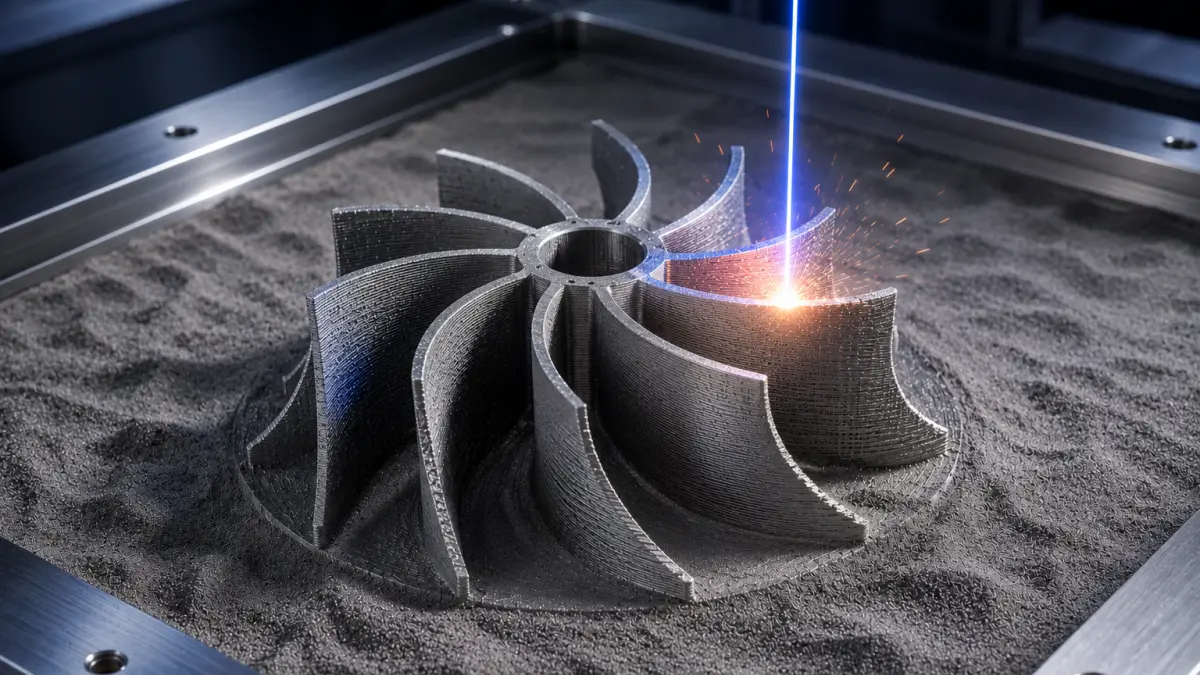
Laser Additive Manufacturing Applications: Enabling the Future of Advanced Manufacturing
Laser Additive Manufacturing (LAM), commonly known as metal 3D printing, is revolutionizing the way complex components are designed and produced. By building parts layer by layer directly from digital models, laser additive manufacturing enables unprecedented design freedom, reduced material waste, and rapid production of high-performance components.
With the continuous advancement of laser systems, galvo scanning technology, and process control, laser additive manufacturing has become a key technology in aerospace, medical, automotive, energy, and industrial manufacturing sectors.
What Is Laser Additive Manufacturing?
Laser additive manufacturing is a process that uses a high-energy laser beam to selectively melt and fuse metal powders or wire materials according to a 3D CAD model.
Unlike traditional subtractive manufacturing methods, which remove material through cutting or machining, additive manufacturing creates parts layer by layer only where material is needed.
The most common laser-based additive manufacturing technologies include:
- Laser Powder Bed Fusion (LPBF)
- Selective Laser Melting (SLM)
- Direct Energy Deposition (DED)
- Laser Metal Deposition (LMD)
- Directed Energy Manufacturing (DEM)
High-speed galvo scan heads are responsible for steering the laser beam accurately across the powder bed, making them one of the most critical components in additive manufacturing systems.
Advantages of Laser Additive Manufacturing
Design Freedom
Complex geometries that are impossible or extremely expensive to machine can be produced directly.
Examples include:
- Internal cooling channels
- Lightweight lattice structures
- Conformal cooling molds
- Topology-optimized parts
Material Efficiency
Traditional machining often removes a large percentage of raw material.
Laser additive manufacturing:
- Minimizes waste
- Reduces material costs
- Improves sustainability
This is especially valuable when processing expensive materials such as titanium and nickel alloys.
Reduced Lead Time
Components can be manufactured directly from CAD files without the need for tooling or molds.
Benefits include:
- Faster prototyping
- Rapid product development
- Shorter production cycles
- Lower inventory requirements
Lightweight Structures
Engineers can optimize component geometry to reduce weight while maintaining strength.
Applications include:
- Aerospace structures
- Automotive components
- Robotics
- Industrial equipment
Aerospace Applications
Aerospace is one of the fastest-growing sectors for laser additive manufacturing.
Typical Components
- Turbine blades
- Fuel nozzles
- Heat exchangers
- Brackets
- Structural components
Benefits
- Weight reduction
- Improved fuel efficiency
- Complex internal cooling channels
- Reduced assembly requirements
Many aerospace manufacturers use additive manufacturing to consolidate multiple components into a single part.
Medical Industry Applications
Laser additive manufacturing has transformed the production of customized medical devices.
Typical Applications
- Orthopedic implants
- Hip replacements
- Dental implants
- Cranial implants
- Surgical instruments
Advantages
- Patient-specific customization
- Improved biocompatibility
- Porous structures for bone integration
- Faster production cycles
The ability to manufacture customized implants directly from medical imaging data has significantly improved treatment outcomes.
Mold and Tooling Applications
Laser additive manufacturing enables innovative mold designs that improve production efficiency.
Typical Applications
- Injection molds
- Die casting tools
- Hot forming tools
- Cooling inserts
Benefits
- Conformal cooling channels
- Reduced cycle times
- Improved product quality
- Extended tool life
Conformal cooling is one of the most valuable applications because cooling channels can follow the exact geometry of the mold.
Automotive Applications
The automotive industry increasingly adopts additive manufacturing for both prototyping and production.
Typical Applications
- EV components
- Lightweight brackets
- Prototype parts
- Battery cooling systems
- Performance vehicle components
Benefits
- Faster development cycles
- Reduced vehicle weight
- Improved design flexibility
- Lower tooling costs
As electric vehicle production grows, additive manufacturing plays an important role in lightweight and thermal management solutions.
Energy Industry Applications
Laser additive manufacturing is widely used in energy generation and heavy industry.
Typical Applications
- Turbine components
- Heat exchangers
- Oil and gas equipment
- Nuclear industry parts
- Power generation systems
Benefits
- Repair and remanufacturing capability
- Reduced downtime
- Improved component performance
- Extended equipment life
The Role of Galvo Scan Heads in Additive Manufacturing
High-performance galvo scanning systems are essential for achieving precision, speed, and repeatability in laser additive manufacturing.
Key Functions
- High-speed laser beam positioning
- Layer scanning
- Hatch pattern generation
- Contour processing
- Precision energy control
Requirements for Additive Manufacturing
- High positioning accuracy
- Excellent repeatability
- Fast response speed
- Long-term stability
- Low thermal drift
Modern additive manufacturing systems rely on advanced digital galvo scan heads to maximize productivity and part quality.
Why High-Performance Galvo Systems Matter
The quality of an additive manufacturing process is directly influenced by scanning performance.
Advanced galvo systems provide:
- Faster build speeds
- Higher part accuracy
- Better surface quality
- Improved dimensional consistency
- Enhanced process reliability
For industrial-scale additive manufacturing, optimized galvo scanning technology is critical for achieving stable production and repeatable results.
Future Trends in Laser Additive Manufacturing
The industry continues to evolve toward:
- Multi-laser systems
- Larger build platforms
- Higher productivity
- AI-assisted process control
- Hybrid additive and subtractive manufacturing
- Mass production applications
As technology advances, laser additive manufacturing is expected to become an increasingly important production method across multiple industries.
Conclusion
Laser additive manufacturing is transforming modern manufacturing by enabling complex designs, reducing material waste, and accelerating production cycles. From aerospace and medical devices to automotive and energy applications, additive manufacturing offers significant advantages over traditional manufacturing methods.
Powered by advanced laser sources and high-performance galvo scan heads, laser additive manufacturing systems continue to push the boundaries of precision, efficiency, and innovation.
For manufacturers seeking next-generation production capabilities, laser additive manufacturing provides a powerful solution for creating high-value, high-performance components.